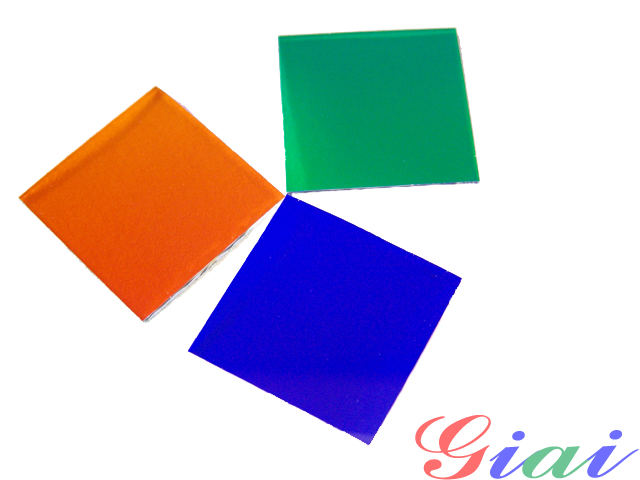
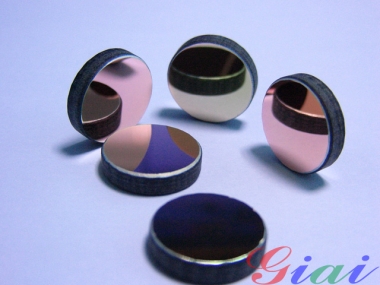
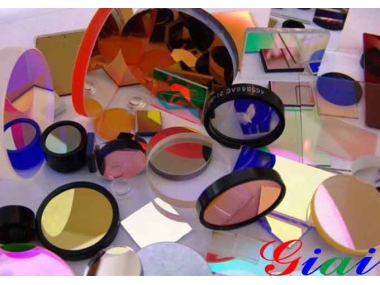
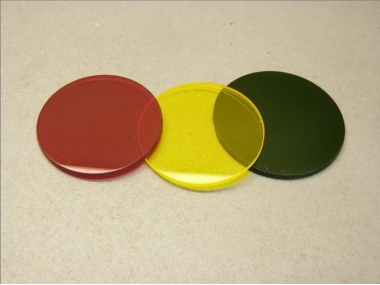
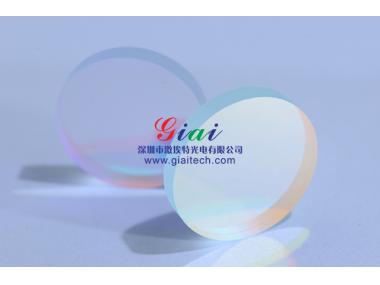
●Product Description
Our short and long-wave pass filters have a steep transition between the region of transmission and reflection — much steeper than colored glass filters. Both the short and long-wave pass filters have out-of-band rejection ³OD 3 to X-ray (for LWP) and to 1200nm (for SWP). Typical transmission is ³80% for long-wave pass and ³65% for short-wave pass filters. These filters are available individually and in sets.
●Product Detail
These short and long-wave pass filters have a very steep transition between the region of transmission and reflection — much steeper than colored glass filters. They have a hard, dielectric filter coating using interference effects rather than absorption to isolate the spectral bands. Unlike colored glass filters, the center wavelength will shift to shorter wavelengths with an increase in angle of incidence. This can be useful for tilt tuning these filters to your exact wavelength. A custom bandpass filter with excellent performance can be constructed using a combination of a short-wave pass and a long-wave pass filter.
Giai long and short-wave pass filters are manufactured using methods and materials designed to deliver the highest spectral performance while providing a robust construction capable of withstanding variable climatic conditions. Transition slopes of £6% are established by a dielectric thin-film coating. This coating is optimized to provide a wide band of high average transmission. Blocking to X-ray on long wave pass filters, and to 1100 nm on short wave pass filters, is accomplished by a combination of reflection from dielectric thin-film coatings, and absorption from filter glasses.
In addition to using these filters in the traditional manner, they can be used to create custom bandpass filters with excellent performance by using a combination of a short-wave pass and a long-wave pass filter in series.
●Specifications
|
Minimum Active Area |
20.2 mm |
|
Surface Quality |
80-50 scratch-dig; F/F per MIL-F-48616 |
|
Diameter |
25.4 +0/-0.5 mm |
|
Thickness |
2.0 to 7.6 mm |
|
Angle of Incidence |
Normal |
|
Tav Minimum Average Transmittance |
Short Wave Pass: 65%
Long Wave Pass: 80% |
|
Rejection (spectral) |
Short Wave Pass: 1.2lc to 1100 nm, =0.1% T or =10-3
Long Wave Pass: X-Ray to 0.85 lc, =0.1% T or =10-3 |
|
Slope* |
£6% where slope%=100% (l80%Tpk-l5%Tabs)/l5%Tabs |
|
Effective Index of Refraction ne |
1.7 |
|
Wavelength Shift with Temperature |
Short Wave Pass: 0.02 nm/°C
Long Wave Pass: 0.025 nm/°C |
|
Humidity |
Per MIL-STD-810E, Method 507.3, Procedure III Modified to 7 cycles |
|
Temperature Range |
-50°C to + 100 °C |
|
Cleaning |
Non-abrasive method, acetone or isopropyl alcohol
on lens tissue recommended |
|
Short-Wave Pass Filters
|
|
Model
|
lc Cut-On Wavelength
@ 50% of Tpk (nm) |
Minimum Spectral range of
Transmittance l1 to l2(nm) |
|
10SWF-450-B |
450 ± 5 |
415–440 |
|
10SWF-500-B |
500 ± 5 |
415–490 |
|
10SWF-550-B |
550 ± 5 |
415–540 |
|
10SWF-600-B |
600 ± 5 |
415–590 |
|
10SWF-650-B |
650 ± 5 |
415–640 |
|
10SWF-700-B |
700 ± 6 |
440–685 |
|
10SWF-750-B |
750 ± 6 |
475–735 |
|
10SWF-800-B |
800 ± 6 |
475–785 |
|
10SWF-850-B |
850 ± 6 |
475–835 |
|
10SWF-900-B |
900 ± 7 |
475–880 |
|
10SWF-950-B |
950 ± 7 |
475–930 |
|
10SWF-1000-B |
1000 ± 7 |
475–980 |
|
Long-Wave Pass Filters
|
|
Model |
lc Cut-On Wavelength
@ 50% of Tpk (nm) |
Minimum Spectral range of
Transmittance l1 to l2(nm) |
|
10LWF-400-B |
400 ± 5 |
410–1200 |
|
10LWF-450-B |
450 ± 5 |
460–1200 |
|
10LWF-500-B |
500 ± 5 |
510–1200 |
|
10LWF-550-B |
550 ± 5 |
560–1200 |
|
10LWF-600-B |
600 ± 5 |
610–1200 |
|
10LWF-650-B |
650 ± 5 |
660–1200 |
|
10LWF-700-B |
700 ± 6 |
715–1200 |
|
10LWF-750-B |
750 ± 6 |
765–1200 |
|
10LWF-800-B |
800 ± 6 |
815–1200 |
|
10LWF-850-B |
850 ± 6 |
865–1200 |
|
10LWF-900-B |
900 ± 7 |
920–1200 |
|
10LWF-950-B |
950 ± 7 |
970–1200 |